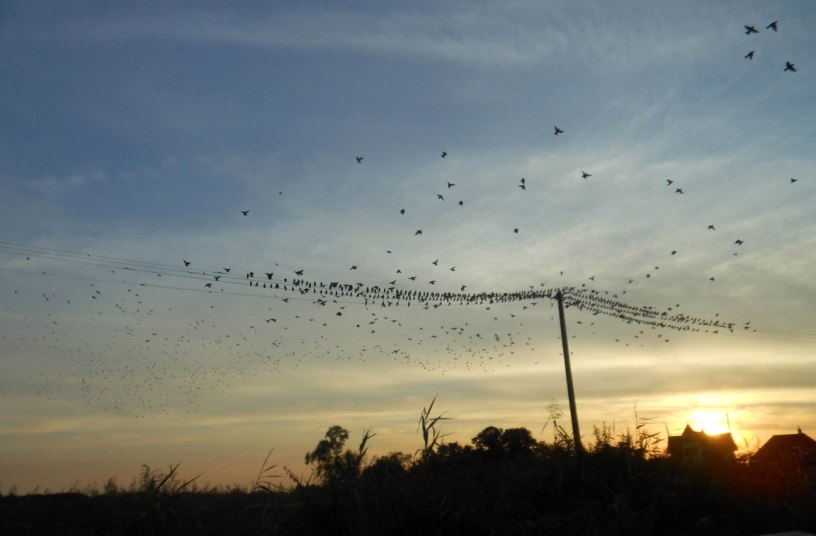
The Latin name just about sums up what most people think about the starling: greedy, noisy, boisterous, numerous and, in a word, vulgar. You may be surprised and possibly not disappointed to learn that starlings are in decline. Regular surveys show that numbers have dropped by 70 per cent since 1975 due to loss of breeding holes in trees and a reduction in the natural food they find in agricultural fields thanks to more intense farming and the increased use of pesticides. However, perhaps because the builders of our Victorian-style houses were thoughtful enough to leave numerous nesting holes in the roof design, we are blessed with an abundance of starlings here, and I want you to take a closer look at this remarkable bird.
Firstly, they are not ‘dark and nondescript’, as most people describe them. During the winter months their plumage is covered all over in white speckles and as spring approaches they develop their breeding plumage. Gone are the speckles, to be replaced with an array of iridescent purple and green feathers which constantly change hue as the sun catches them. Both sexes are similar, but the base of their yellow bills is pink for girls and blue for boys!
Then there is the singing. Not exactly the sweet song of the nightingale, but no bird has a greater variety of sound. Starlings are great mimics, so as well as their own collection of whistles, clicks and squeaks they are very good at car alarms, police sirens and imitating other birds.
Starlings nest in tree holes or in cliffs or on buildings. The male builds a rough nest and the female lines it with soft moss, grass and sometimes aromatic herbs. Yes, they are even into aromatherapy. The chemicals from the herbs are said to be absorbed by the embryo chicks to help them fight infections in early life. I read this in an aromatherapy article so it must be true! They lay five to seven eggs, sky blue in colour, which are incubated and subsequently fed by both parents. In a good year there are two broods.
So now the most exciting thing about starlings – the aerial displays. Huge flocks of starlings bunch together just before going to roost. Thousands of birds twist and turn in a closely bunched flock, making intricate patterns in the sky almost as if they were one entity. After decades of wondering how they do it we now know that each bird just pays attention to its seven closest neighbours and reacts instantly to any move by them. Why seven? Well I don’t know, but if it is any help seven is a prime number.
Peter Land
 Fairfield Matters