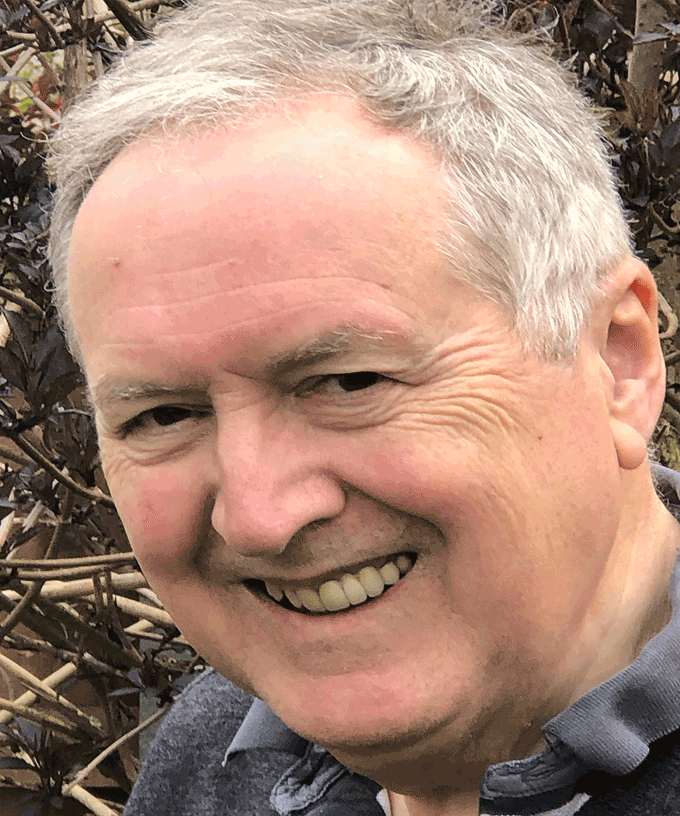
Barrie Dack, founder of Fairfield Parish Council, has announced that he will be retiring at the upcoming election after ten years’ service as a councillor. He sat down with Deborah Kane to talk about where it all began and what the council needs now.
DK: Thank you so much for agreeing to be interviewed today. You used to be a journalist, you must be more comfortable being the one asking the questions?
BD: I’ve got used to it over the last few years! I think the worst thing is when I actually sit in on somebody being interviewed, and I think, That’s a daft question, why are you asking that?!
DK: I’ll try not to ask too many daft questions today.
BD: I don’t mind. I know it’s Victorian in lots of ways but we were properly trained on the job… now you just come out of university and go to work on a national paper, but we went to church fêtes and talked to people – and, the highlight of the week, on a Wednesday evening we rang up the undertakers to find out who had died and then went and knocked on their door!
DK: I can’t imagine that happening now!
BD: It wouldn’t be allowed today at all. To begin with you were absolutely petrified, but usually the person opening the door had never been able to discuss their personal views before, and you gave them that opportunity, so you got a tremendous interview, just an outpouring. You were a social worker as well as being a journalist! And it meant you were involved in the community. In those days, local papers were the social media. If somebody wanted something, they came and banged on your door and said, whatever it was, “We need a new community hall” – and you actually did an awful lot of campaigning, which was great fun. I was in Stevenage at the beginning, really, of it becoming a new town. The number of achievements we got! I got several community centres advanced…
DK: Ah, so your part in getting Fairfield Community Hall off the ground is starting to make sense…
BD: Well I think that’s why Fairfield to me has been quite easy. Because I modelled an awful lot of it on what we did in Stevenage. How we went about it. I never lived in Stevenage but – not blowing my own trumpet – I did have a very good name there. Except by the powers that be, who hated me!
DK: Because you made them spend their money!
BD: Yes! But they were going to spend the money anyway, it’s just that they wouldn’t do it at the right time. And it’s the same here. It was an absolute disgrace that the community hall was lying empty for virtually five years before it actually opened. And if it wasn’t for the steering committee saying that we would take responsibility for it, it would have been longer… It was only transferred last year. That’s another ten years after it was opened.
DK: When did you first move to Fairfield?
BD: It was 2008, so about 15 years ago. I sold my house in Hitchin – it was too big for me – and the buyers wanted to move quickly. So I had to find somewhere. I was thinking of renting, because I didn’t want to rush, but then the estate agent said, Have you been to Fairfield? And I said, I’m not living on an estate! And they said, Well, no, you ought to go and look. So I looked at a few houses and I thought it was rubbish, but then there was one more house I’d booked to look at, so I went there – and that was the house I bought!
DK: So you liked the house, but not Fairfield?
BD: Well, because it was a new build estate and I like older houses. Having said that, I think – I’ve moved around an awful lot in my life. I was born in Letchworth, moved to Baldock, moved to Hitchin, then the other side of Hitchin, and now to Fairfield. So I’ve really seen the world! – I just think this is the happiest, most social place.
DK: Did you always feel that, even in the early days?
BD: Even when I first moved here there were social groups. People would go into one another’s houses on Saturday nights and there would be 20, 30 people there… because there wasn’t anywhere else to meet. And the Fairfield Park Residents Association had a very, very good social committee. We used to run no end of events in the Urban Park for young children, which I suppose was the forerunner of the community hall. We raised an awful lot of money for bulbs, and volunteers came out to plant them, too, so there was a really good community spirit. And I don’t think you’d get that in developed towns.
DK: It’s something about everyone being new, isn’t it? Everyone being invested in getting to know their neighbours all at the same time.
BD: I also think it’s the people. In some streets you find neighbours are much closer than in others – like Brunel Walk used to be very close knit. It’s a little bit less now, as people have moved in and out, but very early on they had a very strong bond. I used to be a key holder for the bollards and I got a call one morning saying there was an emergency, they needed the bollard taken down for access. And then we found out that the lock had been changed so we couldn’t remove the bollard. But it wasn’t a problem, because about eight people came out of their houses and helped to lift the stretcher over the top. You don’t get that in a lot of roads!
DK: It must have been very soon after you arrived here that you started to get involved in things. You’ve already mentioned the FPRA and the community hall… what about Fairfield Parish Council?
BD: The idea for the council came a bit later. Three months after I moved to Fairfield I was diagnosed with cancer, and then I was not around for a long time because I couldn’t look after myself, so the house was empty. But after that, in 2011, I received my council tax calculation, and I thought, Why do we pay that to Stotfold, they don’t do anything! We’ve got our own management company, so what’s that money for?
DK: Lots of people ask questions like that – they’re all over Facebook. But you actually decided to do something about it.
BD: At one of the steering committee meetings for the community hall I said, Does anybody know why we pay council tax to Stotfold? A few people pricked up their ears. And Geoff Smith and I arranged a meeting with the then chairman of Stotfold Town Council. We asked him, What does Fairfield get for this money? And he said, We can’t do anything at the moment because of the way it’s set up – so we were effectively subsidising Stotfold. So I said, Well, there will be a time when you can do things in Fairfield, so are you putting that money aside for later? And he looked at me as if I was mad!
DK: Which just confirmed that you were right.
BD: So we came away and thought, well, what can be done? And then I did a load of research about setting up our own parish council. It looked fairly hard, but I asked for a meeting with CBC, and I met Brian Dunleavy, who did his best to put me off…
DK: He obviously failed!
BD: It shows the community spirit, because it wasn’t just me. We did one leaflet telling everyone in Fairfield about the possibility of having our own council, and then we went out with our petitions and out of 1700 possible signatures we got over 1200! And the critical number was seven hundred and something. So then I took the petition in to Brian Dunleavy and he nearly fell off his chair! But then it still didn’t end there, because CBC were totally against it and they wanted to arrange meetings between us and Stotfold Town Council to try and mediate.
DK: Didn’t you spend some time as a councillor on Stotfold Town Council?
BD: Haha! Geoff Smith and I did that deliberately, so that Fairfield had a voice. We had great fun! Geoff got told to sit down a lot – because he is a bit outspoken. “You’re totally out of order, councillor, sit down!” So I then would stand up! After Fairfield broke away, STC were angry for several years. I think the anger is really only subsiding now. But so what? We’ve got the money now!
DK: So you got agreement in 2012 and then Fairfield Parish Council was formed in 2013 – which is ten years ago now.
BD: Yes, I think we were really lucky. Of all the people who campaigned only three of us wanted to stand, and we needed seven councillors altogether. But we put out the message in Fairfield Matters – which I started! – and we got good people. Each councillor had a skill that we needed, so we had knowledge about roads and transport, planning, housing… We were also really lucky in getting Katrina as clerk – she’s one of the most highly qualified clerks in the area. She was at Ickleford Parish Council for 11 years and she really knows all the legal side. So everybody knew their role, and everybody worked together.
DK: What were some of the things that were accomplished in those early years?
BD: When CBC were deciding on sites for travellers – this was actually just before the council was formed, so it was the FPRA, but the same people were involved – they wanted to have a site by Lower Wilbury Farm. We put together a dossier on that, which wasn’t against travellers at all but was all about showing the unsuitability of the site… so that was one thing that we did well. And the neighbourhood plan came together in double-quick time because of the knowledge and experience we had on the council.
DK: Do councillors need to have a certain type of knowledge or experience to be useful?
BD: Well, you ought to have one person on every council who understands finance, because that’s always going to be involved. But there are lots of other skills that can be useful. Fairfield’s in a difficult position because we actually need far more people to do managerial roles than most towns and villages. The management companies all need at least five or six people involved, so you’ve got those positions, and you’ve also got the seven seats on the council.
DK: There is some overlap, though, isn’t there? You and Nick Reynolds are on both FPC and the FPRA; Nick Andrews and yourself are both Community Hall Trustees…
BD: I get that thrown at me an awful lot: It’s all the same people. I would argue against that until the cows come home. The management companies look after the assets, and that’s their only role. They do nothing on the social side, the community side – that is the parish council’s role. And we’ve never had a conflict yet. I suppose there was historically a bit of a tussle between Fairfield Hall and Fairfield Park, but that’s largely been overcome now.
DK: Well that’s one of the things that the parish council is there for, isn’t it – to bring everyone together and smooth over the differences between different groups.
BD: Yes. Someone said to me why isn’t the council made up of one person from each ward, but the warding system isn’t as simple as that. There’s got to be a minimum population in each ward. It’s a nice idea, but it just wouldn’t work. But we have got to a point where we’re all working together well now – the council and the management companies.
DK: So what does FPC need to take it forward into its second decade? Most of the founding members have left; you and Penny Daffarn are the last two and you are both retiring at the upcoming election… what happens next?
BD: Well there are lots of things at various stages that need taking forward. Like for example the garden of remembrance. That came about because when we broke away from Stotfold we lost our burial rights there – we pay a premium now. So we need somewhere in Fairfield that ashes can be interred. There was lots of ground work that had to be done on that, and then it stalled for two years because of Covid. And we looked for snakes for six months…
DK: Was that what the carpet tiles were for near the old hospital cemetery?
BD: Yes. And they didn’t find any snakes, so that was a disappointment! Total waste of money, but it had to be done. But it’s now at the point where we’ve done all that and the designers can move in to produce a design, and there will have to be a consultation… so there’s a marvellous opportunity to get involved just when things are starting to happen, with all the ground work having been done. So that’s one thing. I’ve also got a teams meeting this afternoon on what will be my last initiative, which is to look at green energy in Fairfield – for the whole village. Now obviously my involvement will most probably be this afternoon and this afternoon only – so there’s another thing that can be taken on by someone new.
DK: That’s very forward-thinking. Is it really something that could happen for the whole of Fairfield?
BD: Well, I had the idea because someone had told me that there was a village in south Cambridgeshire that had put in a ground- and air-source heat pump system for the whole village. And I thought, well, that’s a good idea, because we’ve got enough space in Fairfield for that – not knowing that it actually cost £11million and was paid for by South Cambridgeshire District Council. And it was only a village of 450 people, so I can’t see where the break even point is in that! But we will be discussing that this afternoon, so we’ll see. There’s lots to look into, and a new councillor could take that forward. I mean, it would be hard work. Nothing’s easy. But if you’ve got determination then you can do it.
DK: How about youth engagement, that was one of your manifesto points at the last election. Is anything happening on that?
BD: One thing that’s tentatively proposed is to put in a natural adventure playground in that area where the garden of remembrance and the allotments are going to be. And FPC also engages with youth workers and police over antisocial behaviour – not just reactively, but proactively. It would be good to have a councillor who would like to take that forward.
DK: What about new projects? How easy is it for a councillor to come in and pitch their own ideas?
BD: That’s one of the most important things. All the councillors are asked, two weeks before the meeting, to put forward ideas for the agenda. Sometimes people put crazy ideas forward, which just get thrown out, but that doesn’t matter. There is always a danger that someone would come to the council because of one issue that they feel very strongly about, and then not get involved in anything else. You really need people who have a broad vision for Fairfield. But they don’t have to agree with everything – that’s democracy.
DK: I think it’s important that councillors don’t agree on everything – you need people from across the community who come from different backgrounds and hold different views. One of the preconceptions about being a councillor is that it takes a lot of time, which means working people are less likely to volunteer. How much time is really involved?
BD: I’m not a good person to ask! I’ve been spending about 20 hours a week since 2011, but that’s because I get involved in everything – I’m just one of those people, just nosey! But you don’t need to do that. I suppose you’d need to devote at least one evening a week to it, which you can still do if you’re working.
DK: And what kind of person makes a good councillor, in your view?
BD: People have got to have a feel for Fairfield and be proactive. We were very proactive to get the council, and over the last ten years we’ve been proactive, but there is a danger now that we just become reactive, unless people go in with the right ideas. Being a councillor is much more than just attending meetings. You have to take part in discussions, and you have to have ideas. There shouldn’t be any party politics – we have no power to influence national politics anyway, so it should just be about improving the village.
DK: I think most residents would agree that you have certainly done your bit to improve the village over the last ten years. Thank you very much for all you’ve contributed, and of course for sharing your thoughts with me today.
Deborah Kane has lived in Fairfield since 2010 and is a regular contributor to Fairfield Matters.
 Fairfield Matters