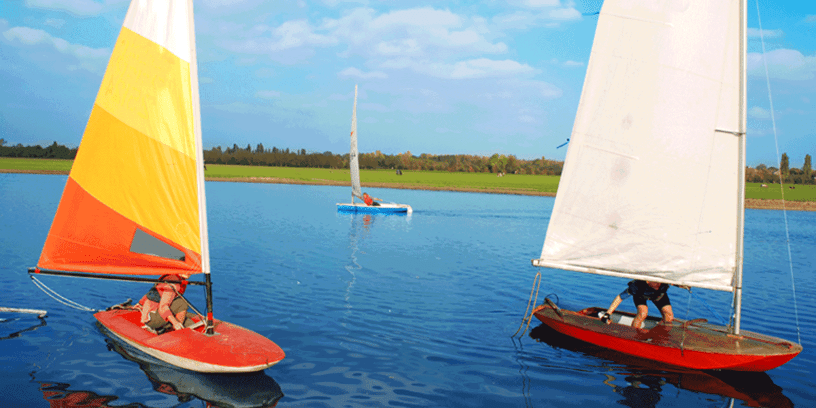
Steve Sleight opens his excellent book ‘The Complete Sailing Manual’ with the following statement: “Sailing is both the most relaxing pastime imaginable and the most complex sport in the world”. For me it’s always just been a (mostly) relaxing pastime – I’ve never been particularly interested in competitive sailing. Why am I telling you this? Well, there are two reasons: firstly, May is National Watersports Month; and secondly, we have a sailing club on our doorstep! So now is the time to find out what sailing is all about.
North Hertfordshire and East Bedfordshire (NHEB) Sailing Club is based at the Blue Lagoon, just on the western border of Fairfield Park. When I moved to Fairfield a couple of years ago I really liked the idea of a sailing club within walking distance of my house! The club is holding an Open Day on Saturday 13 May between 10am and 4pm, and everyone is welcome to pop along and find out about sailing, windsurfing, paddle-boarding, and about the club. You can even go out on the water for a taster session with an experienced sailor if you want to. I’m not presently a member of the club so I’ll leave it to them to tell you more, but why not go along to the Open Day and see what they have to offer? Their website is http://www.nhebsc.org.uk.
It’s never too late to start sailing – I took my first dinghy training course at the age of 47 so that I could sail together with my son who had recently gained a Youth Sailing Scheme qualification from the Royal Yachting Association (RYA). A year later I took an advanced course (I was completely out of my depth, and have no idea how I passed it), and a year after that I took a multihull training course that enabled me to sail catamarans – very fast boats, and lots of fun!
Getting started is easy. You can sign up for a RYA National Sailing Scheme (the ‘adult’ training scheme) Level 1 course at any RYA-affiliated club. This two-day course will generally be run over a weekend and will give you an introduction to the basic theory and practice. This is followed by the Level 2 course (another two days), which is the minimum qualification that sailing clubs require to let you sail on your own. Children can sail alone after achieving the Youth Stage 3 qualification.
Sailing doesn’t have to be expensive. I’ve never owned a sailing dinghy – all my previous clubs have had ‘club boats’ that are available for members to use, either free of charge or for a small fee. I certainly recommend starting your sailing journey somewhere that has these club boats so that you can try a few out and decide which you like. The Laser is a very popular singlehanded racing dinghy – it’s the boat in which Ben Ainslie won a gold medal for Britain in the 2000 Summer Olympics in Sydney. Every club will have a Laser fleet, but despite its popularity I have never liked the Laser. Thankfully I had enough free of charge experience in this class to realise that it wasn’t for me, without making the costly mistake of buying one.
Sailing is a relatively safe pastime. All clubs require sailors to be able to swim a short distance (usually only about 10 metres), to wear a buoyancy aid when on or near the water, and to wear a wetsuit in the colder months. Your boat will capsize (tip over and dump you in the water!) at some point in your sailing career, but your training will prepare you for that, and give you the skills necessary to safely get upright and moving again – and there is usually a ‘safety cover’ speedboat on standby just in case.
I’ve had a huge amount of pleasure and fun sailing, usually messing about on the water in a light breeze on a summer’s day. Occasionally I’ve felt a bit ambitious and tried to push myself and learn new skills, but that really isn’t essential – whether it’s a pastime or a sport is entirely up to you! So why not give it a try on 13 May?
George P
 Fairfield Matters